The audience is first lured to peer through a small hole, curious to witness Alice in her little house. But upon opening the door, they do not find Alice. They encounter the back of themselves instead.
How easily we trace the flaws and mistakes of others, how naturally we observe the lives unfolding outside us. Yet the mirror turns slowly inward. We are often the last to recognize the quiet fractures and hidden beauty within our own selves.
Arduino · Processing (Java) · Camera · MacBook · Wood


On view at tiat, SF — Epistemologies of Slop
An immersive installation exploring AI mukbang, ASMR, and the epistemology of slop. It is organized around the question of what it means to trust what we consume, see, and feel through a screen.


feed me is a 1:1 encounter with an avatar that mirrors the most-viewed AI mukbang video on YouTube in real time. The performance of eating without hunger, without body. It eats for you. The copy has become the source. The avatar shifts look from one AI mukbang to the next. It doesn't parody AI mukbang. It becomes the perfect mukbanger, eating as pure performance. From Will Smith Eating Spaghetti to this, glitch optimized into synthetic intimacy, the meme perfected, and the viewer, satisfied.
When an avatar mirrors the most-viewed AI mukbang creator with same food, same sounds, same intimacy, but no body, no hunger, no need, who is the source?
The copy doesn't refer back to an original anymore. It is the thing. Banana milk doesn't taste like bananas. It tastes like banana milk. Las Vegas isn't a fake city. It's just Vegas. The simulation swallows the original.
And when it looks at you, feeds you, makes you feel known. Was the intimacy ever about who was on the other side?
Inspired by Alan Lightman's Einstein's Dreams. In his essay dated April 24, 1905, he imagines a world with two kinds of time: mechanical time, rigid and predetermined, and body time, fluid and unpredictable.
In this world, there are two times. There is mechanical time and there is body time. The first is as rigid and metallic as a massive pendulum of iron that swings back and forth. The second squirms and wriggles like a bluefish in a bay. Each time is true but the truths aren't the same.
— Alan Lightman, 24 April 1905
Building on this, I envisioned a world where time follows the rhythm of one's breath and heartbeat. To explore this, I created a prototype where a microphone detects the speed of a participant's breathing and adjusts the tempo of a clock accordingly. The faster or slower you breathe, the faster or slower time itself seems to pass.
An urban intervention designed to create small moments of pause in the fast pace of city life. Installed on top of street signs, traffic lights, and the corners of buildings, the mushroom-like sculpture points toward the sky, gently inviting passersby to look up.
In cities, our eyes are often fixed on phones, traffic, and the ground beneath our feet. Funji interrupts this downward gaze, offering a playful reminder to take a breath and shift perspective. By simply noticing the sculpture and following its direction, people momentarily disconnect from the rush of urban routines and reconnect with the larger world above them—the sky, the clouds, the changing light.
The name combines "Fun" with "Munji" (the Korean word for dust), nodding to the cycle of "dust to dust, ashes to ashes." Funji transforms something as small and overlooked as dust into a whimsical guide for reflection.
A real-time kaleidoscope built from a live camera feed, paired with generative sound tied to color shifts in the image. Participants see themselves refracted into abstract, symmetrical patterns.
The piece draws a line between the Zen Buddhist path to happiness — appreciating who you are, seeing beauty in things, enjoying small things around you — and the way a kaleidoscope imparts symmetry and beauty onto whatever sits in front of its lens. Seeing yourself this way, fractured and reassembled into pattern, opens a small door onto self-acceptance.
Built in Processing: a live camera capture is flipped, rotated, and repeated into a hexagon, then that hexagon is rotated and redrawn eighteen times to fill the screen. Sound is generated from the shifting difference between the video's live color values and a set of pre-defined reference colors, sampled every 30 frames.
Arduino · Processing (Java) · Camera · MacBook

What remains at the end of the day are the traces of how we lived — how gently and honestly we treated ourselves, how meaningfully we connected with others, how we contributed to something larger than ourselves.
Dust grew out of that desire for connection. As a student living far from home, I imagined it as both a friend and a bridge — a companion carrying the presence of loved ones across distance. Not just an object, but a living interface between solitude and community.
Dust is a gift of presence. Friends send their voices through a Facebook app, and the small pin, worn on a jacket or close to the heart, becomes their messenger — interrupting the silence of everyday life with a vibration, a sigh, a whisper, a laugh. When stroked, it responds with small affirmations, transforming into a companion that blurs the line between solitude and community.
Dust asks us to imagine technology not as a tool of efficiency, but as an evocative object — an interface for tenderness, a reminder that care can travel across distance, and that even circuits can carry love.
Custom circuit · Microcontroller · QProx capacitive sensor · Vibrating motor · Speaker · 3×2 in
At just 3×2 inches, Dust contains a custom circuit, microcontroller, QProx capacitive sensor, vibrating motor, and speaker. Yet its real substance lies in what Brian Eno once called “the big here and the long now”—a small device that stretches presence across distances, holding space for connection in fleeting moments.

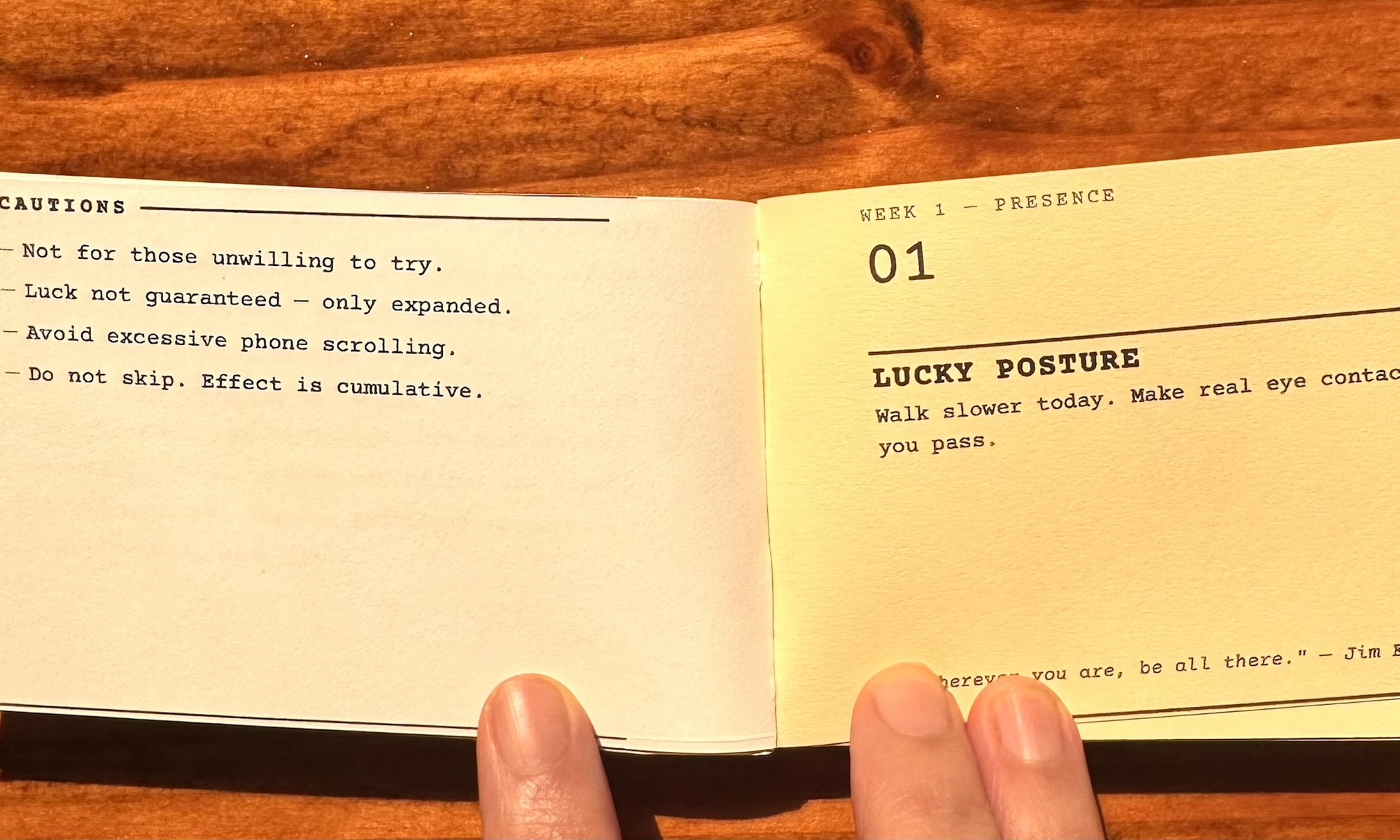
A way to resist automation and mass production. A way to express in the most labor intensive format.
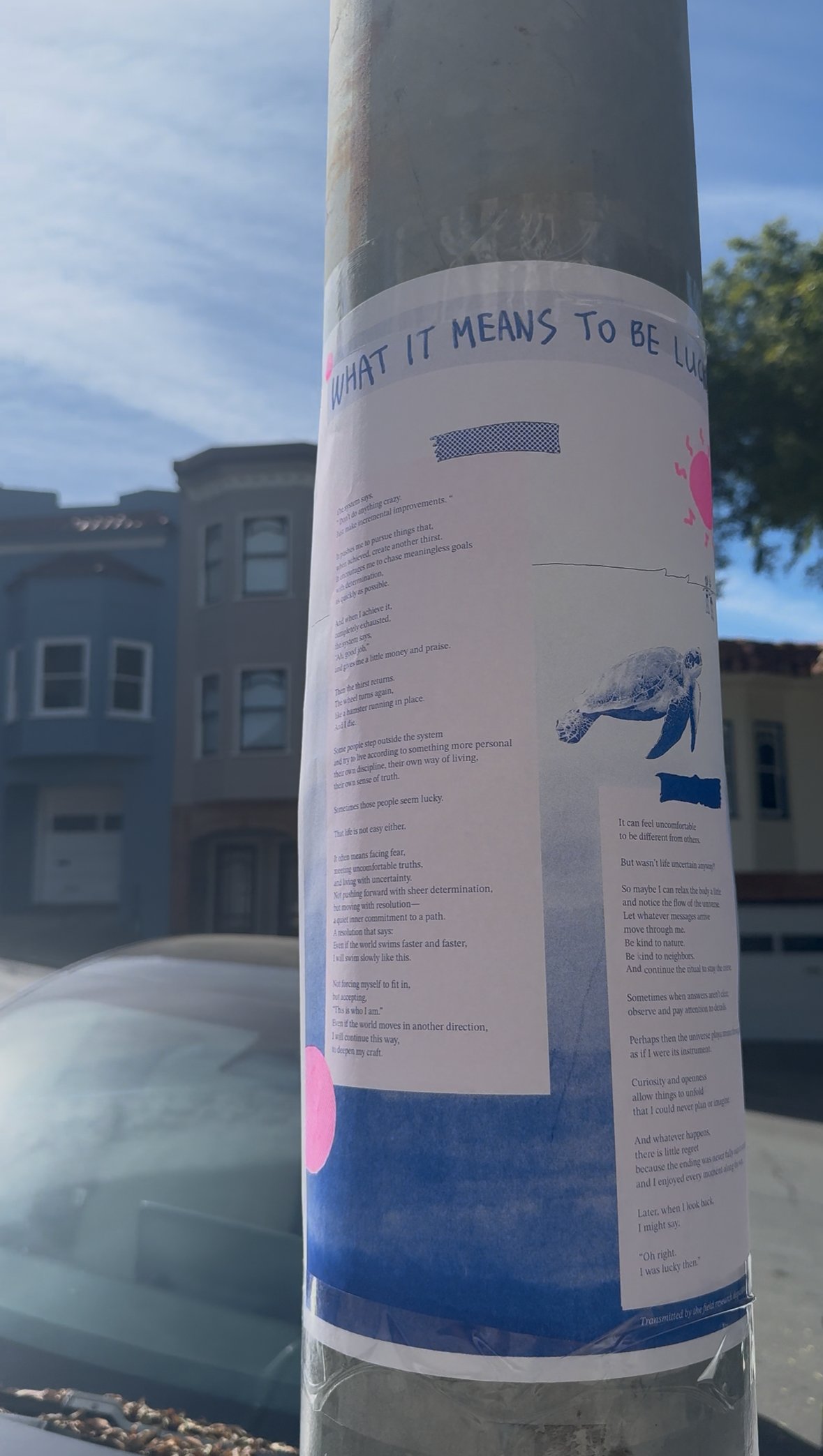
A San Francisco–based art practice making prints, books, and objects that expand your relationship with luck, connection, and the present moment.
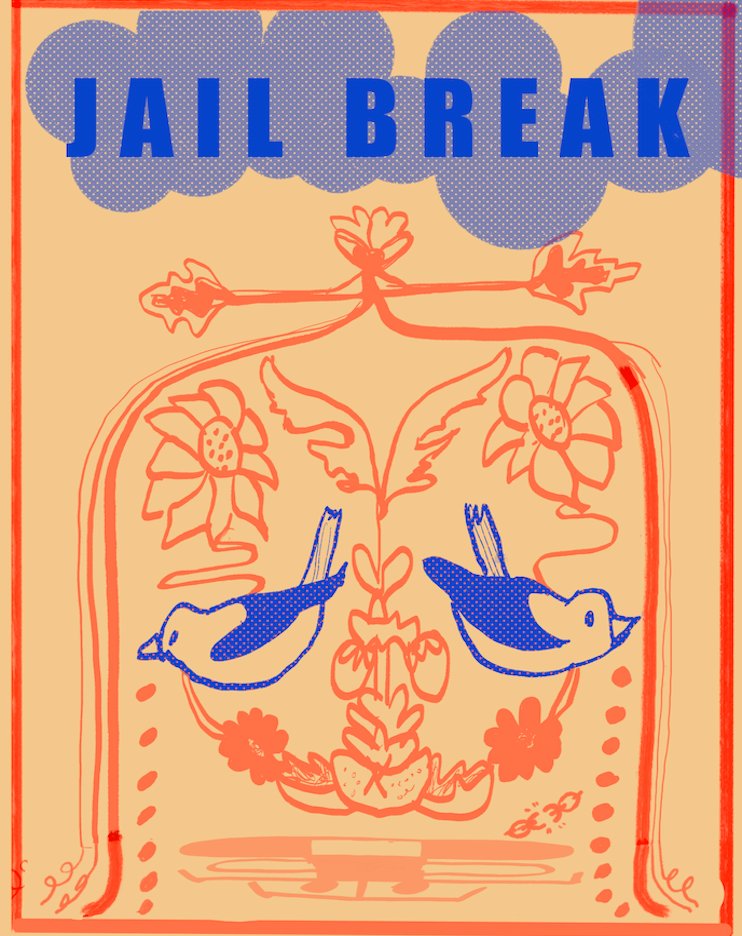
"I release what holds me back."
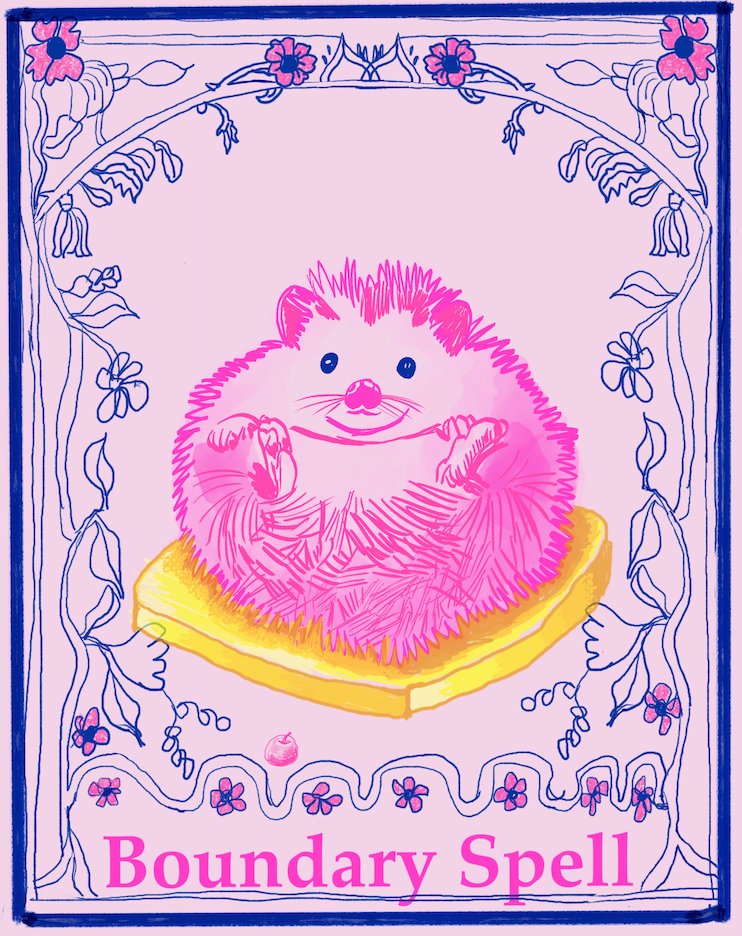
"I am safe in my own energy."
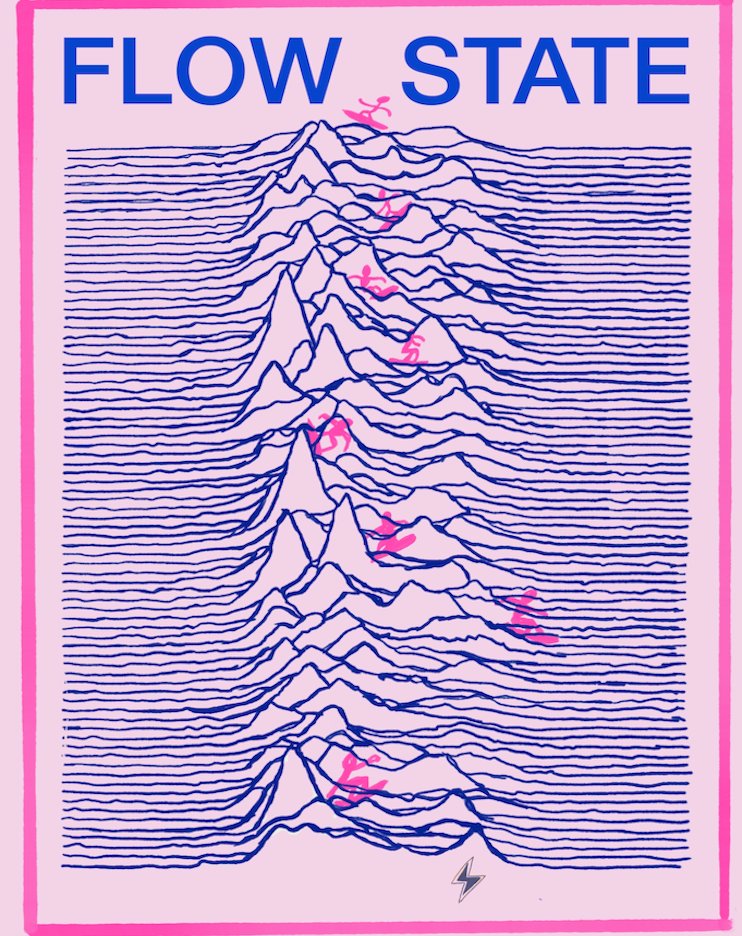
"I move with what flows to me."
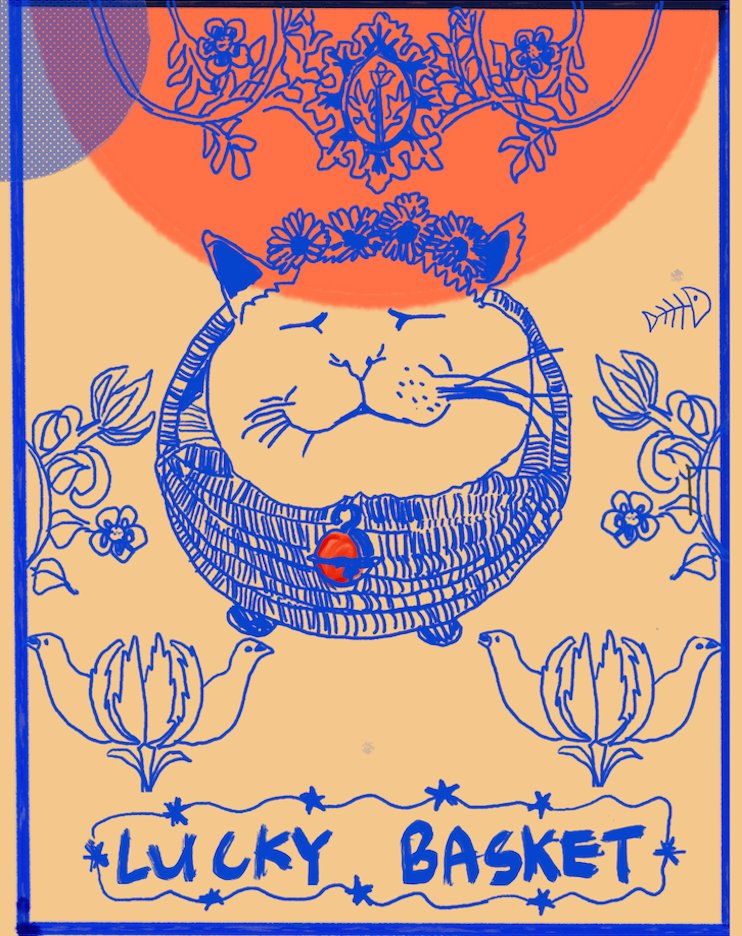
"Opportunities find me."
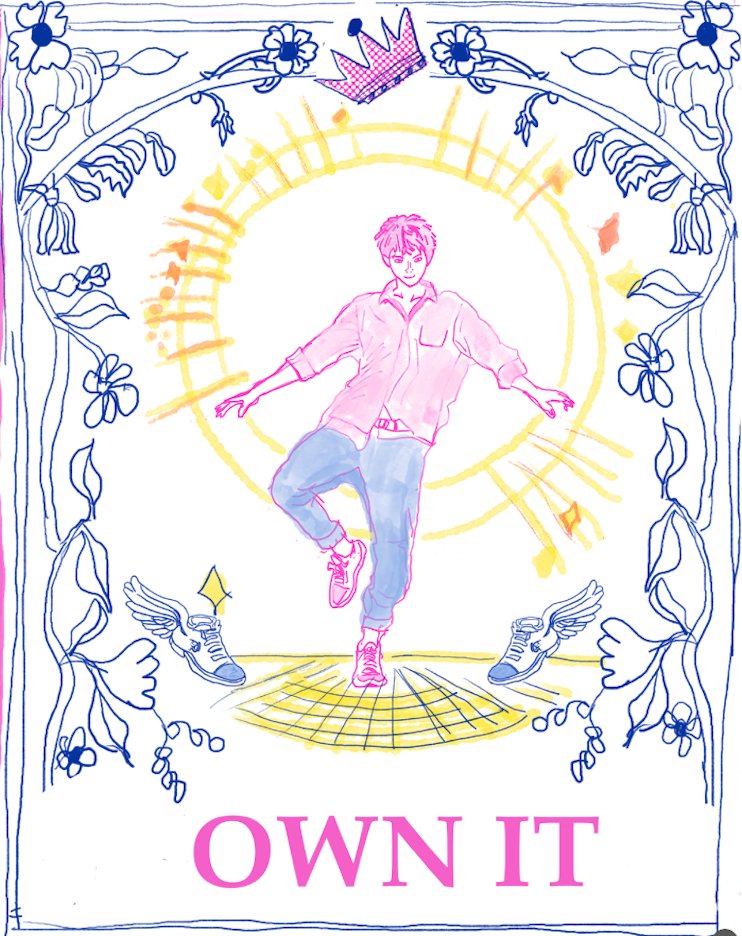
"I own all of who I am."
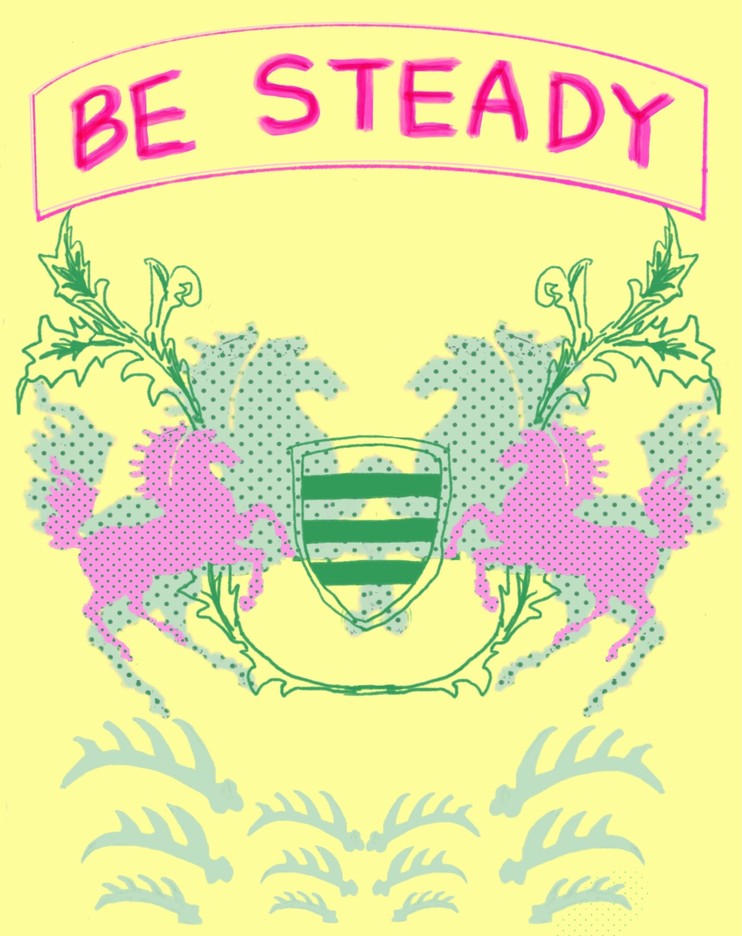
"I stay the course."
I was observing daily life and writing essays when these started appearing. Blueprints for machines I dream about, and for the utopia I'm working toward. Each one could go in many directions. Do any of these resonate? Email me to collab.


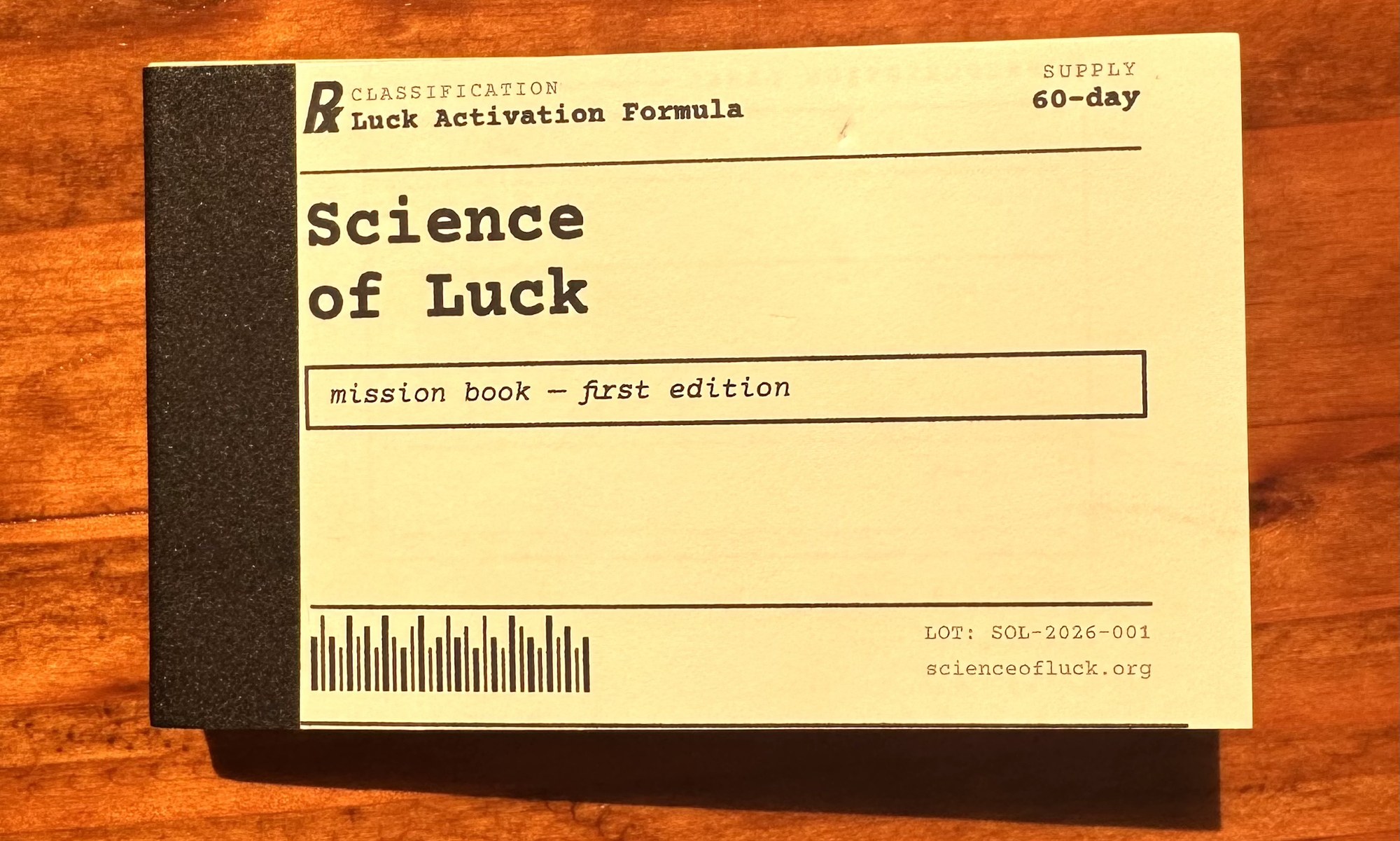
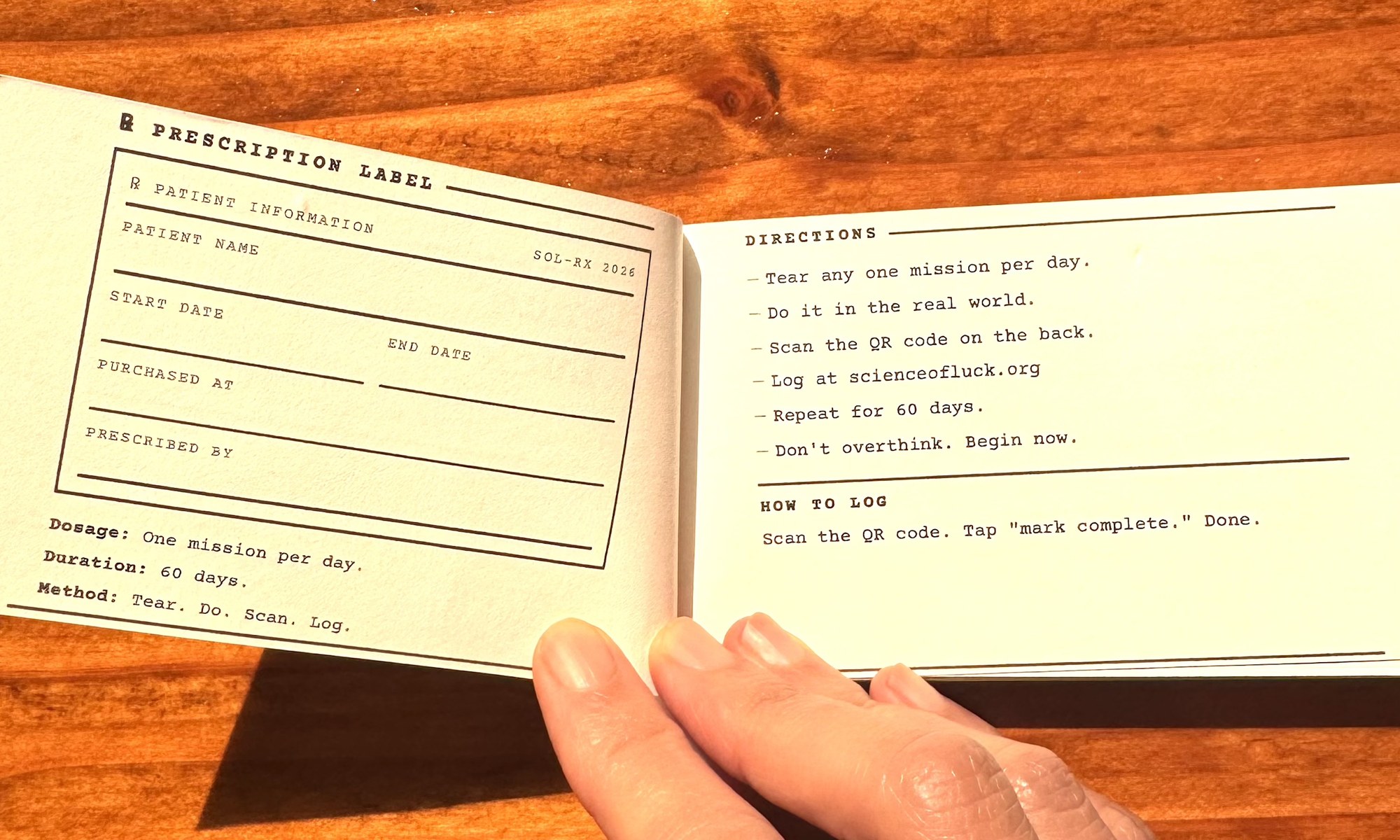
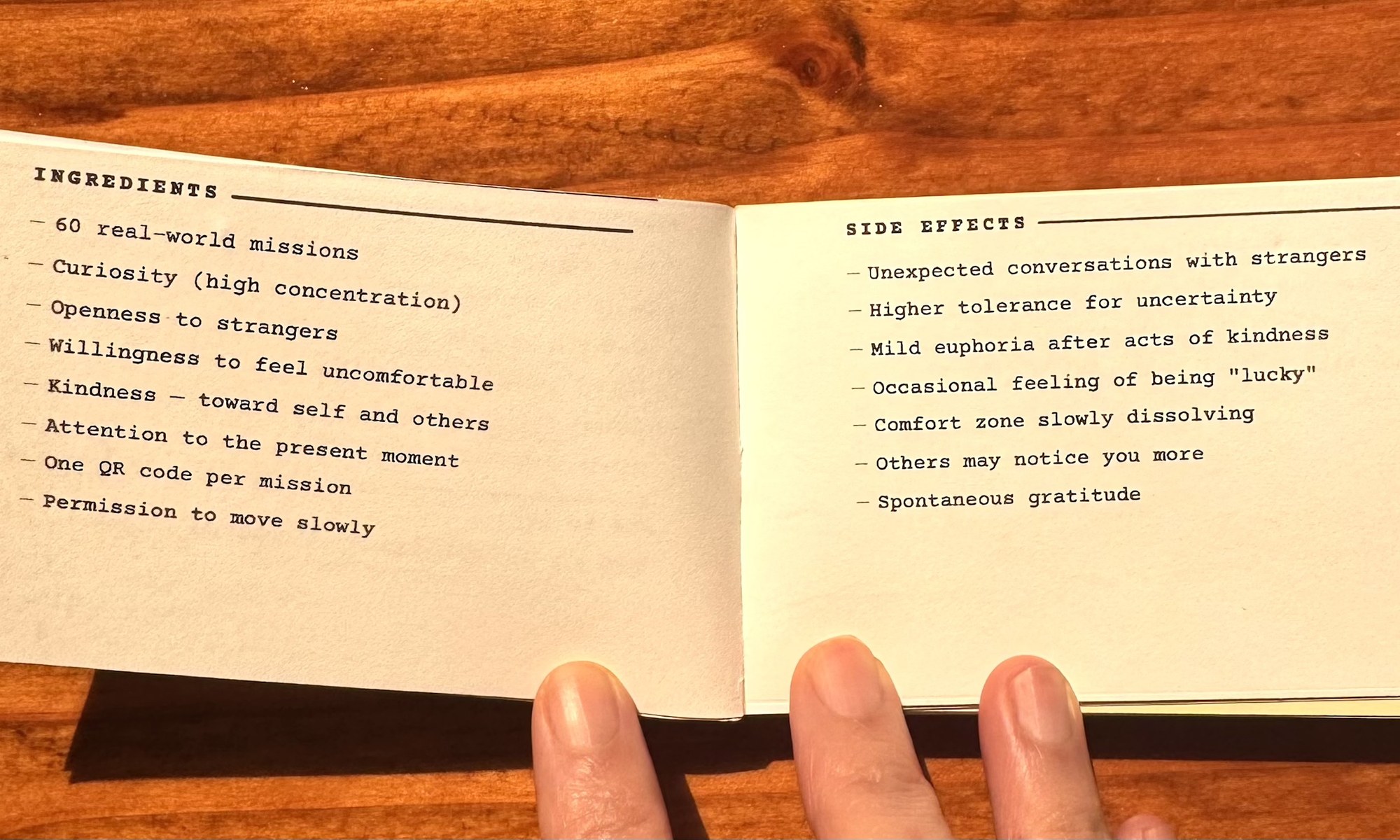
60 real-world missions. One a day. Logged live.
Each day, tear off a mission from the book and do it. Scan the QR code on the back to log your action to the global feed — a live record of strangers completing small acts of curiosity, connection, and presence around the world.
The feed is a collective document. Every entry is someone who stepped outside their routine for a moment and let the universe play through them.
Start a conversation. Ask deeper. Let it go where it goes.
Artist based in the San Francisco Bay Area. Working across internet culture, the handmade, and the space where physical and digital experience meet.
Her work reveals beauty in the ugly, surfaces the unknown, rediscovers the forgotten. It is a resistance against the violence of sameness, the flattening that comes from the pervasiveness of social media. Art is thought experiment, a way to ask questions, think out loud, and make friends.
Past life: helped people build mobile games and MMORPGs. Trained in Industrial Design at KAIST (BS) and Interactive Telecommunications at NYU's ITP (MPS).
Find her somewhere in San Francisco with guitar in hand, dog Max beside me, putting up posters about what it means to be lucky. She reads about philosophy obsessively, ancient to contemporary, and love a good conversation about simulacrum, what AI is doing to art, and where the two meet.
I write and paint as a way of staying with things a little longer.


RIPE RIS Live provides a real-time stream of global internet routing activity: networks announcing, withdrawing, and rerouting paths across the world as they happen. It is not a human-filtered page, advertisement, interface, or image. It is the raw behavior of the network itself.
Jean Baudrillard's Simulacra and Simulation argues that media-saturated culture replaces direct experience with signs and images that no longer refer to reality. Any AI-generated immersive field risks becoming another screen simulating awe in a culture already saturated with generated images.
mimesis resists this structurally. It does not imitate the sublime through representation. Instead, its behavior is shaped by real-time signals: the visitor's stillness and sway, and RIPE RIS Live's actual routing activity as it happens.
This makes the work closer to smoke from a real fire than a picture of fire. It is a physical trace of something real, translated into a form the body can feel.
Many historical sublime artworks use the human figure as a calibrating instrument. In Friedrich's Rückenfigur paintings, the figure seen from behind gives the viewer a known scale, then directs the gaze toward fog, sea, mountain, or void. The sublime is felt through the ratio between the human body and what exceeds it.
Friedrich could not know who would stand before the canvas, so the figure inside the image becomes a surrogate for a live encounter the medium could not produce.
mimesis replaces that surrogate with the actual visitor. Through camera-based sensing, the system reads stillness, sway, and body presence, allowing the field to respond to the specific body in the room.
Turrell and Eliasson moved the sublime beyond depiction by placing real bodies inside fields of light, color, atmosphere, and perception. mimesis builds from that lineage, but shifts the interaction into a computational loop. The vastness changes in response to this specific body.
Ten of Burke's criteria from A Philosophical Enquiry into the Origin of Our Ideas of the Sublime and Beautiful (1757) as the artistic framework.
| Obscurity | never let the field resolve into a nameable object |
| Power | response the visitor cannot prove or direct |
| Vastness | scale exceeding the body, no visible frame or edge |
| Infinity | recession without a locatable vanishing point |
| Artificial infinity | repetition keyed to sustained stillness, uniform enough that counting gives way to surrender |
| Privation | soft darkness, one figure alone in open space, sub-bass felt before heard |
| Magnificence | profusion without visible order or symmetry |
| Light in extremes | light pushed toward erasing the field, not just revealing it |
| Difficulty | the piece communicates the scale of effort and infrastructure required to exist, even wordlessly |
| Terror | the piece keeps, and actively builds toward, structural vulnerability (restricted visibility, ground/depth ambiguity, exposure) that speaks to the same alertness as a cliff edge or open water, without ever depicting a cliff, a ship, or a storm |
| Visual language prototyping | 500 | Routing-based visual behavior tests, system-state studies, projection studies |
| Real-time pipeline build + stability testing | 500 | RIPE RIS Live ingestion, body sensing, AI interpretation, long-run tests |
| Rehearsal + on-site tuning | 400 | Pre-opening tests with visitors, calibration in Gray Area's space |
| Exhibition run: live inference + fallback cache | 900 | Continuous gallery-hour inference, cached states, and local rendering for continuity |
| Contingency | 700 | Connection drops, recalibration, extended run, heavier inference if needed |
| Total | 3,000 | Planning estimate against GPU-hour allowance |
| Grain | clusters and disperses with routing entropy, never resolves into a shape |
| Color | hue and luminosity drift with churn and stillness; no edges, no object |
| Turbulence | intensity tracks routing instability; highest risk of reading as "clouds" |
| Light | oscillates toward overexposure on bursts, near-darkness in quiet stretches |
| Repetition | each interval of held stillness spawns a new iteration, reshaped by that instant's data |
| Recession | depth set by live path length; no horizon for the eye to rest on |
| Grain | granular synthesis, density tied to the same routing entropy |
| Color | slow timbral/pitch drift with churn and stillness, a tonal hue, not a melody |
| Turbulence | filtered noise swelling with routing instability, same "reads as ocean/wind" risk as its visual counterpart |
| Light | dynamic range extremes, near-silence to full, sub-bass presence rather than volume-as-aggression |
| Repetition | each interval of held stillness reinforces or adds a layer, the same signal already driving the visual |
| Recession | reverb depth / perceived distance tied to live path length |
Obscurity applies to sound too: no identifiable instrument, no recognizable melody, nothing a visitor could name afterward. Silence is the real-vulnerability lever here (parallel to restricted visibility), never a startling sound effect, which would be depicted content.